
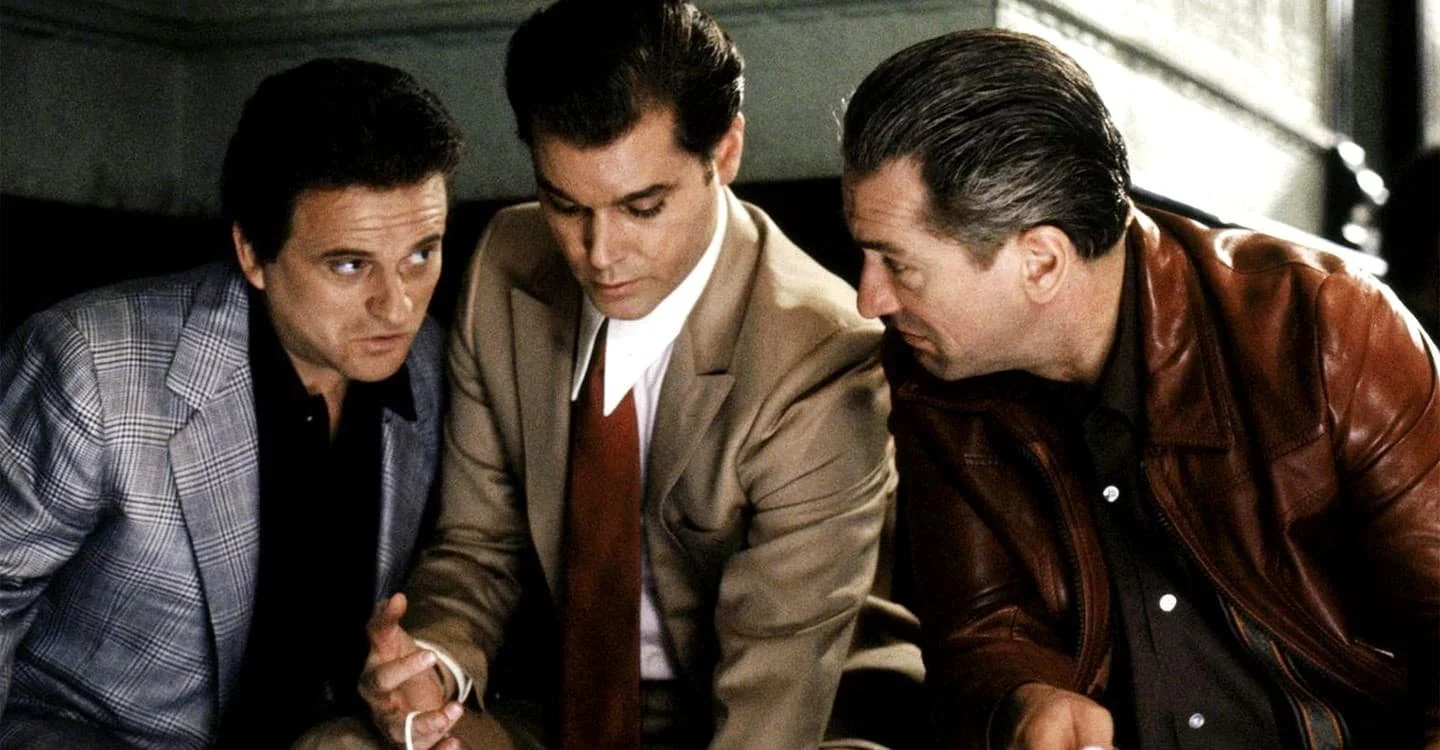
After doing a couple of war movies, I’m happy to be with something fun.
Well, it’s still people killing each other and ruining lives, but at least it’s a fun version of this. This is one of the most beloved movies on the list, and it’s one of the rare cases where a movie gets to be both highly esteemed and a comfort movie at the same time.
So get your shine boxes. We’re here with 1990’s Goodfellas, written by Nicholas Pileggi and Martin Scorsese and directed by Scorsese.
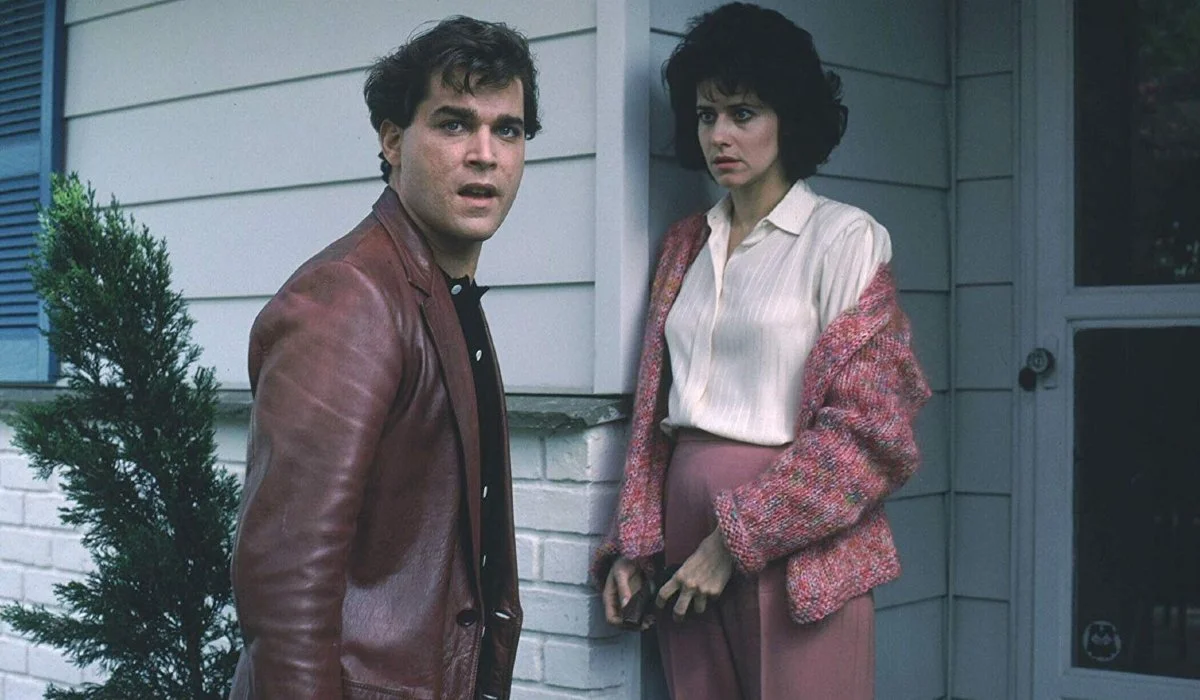
Since this is a war movie of its own, we can see if that theme of “war is hell” applies here. Mafia life is hell? Yeah, but interestingly, it’s also heaven for a lot of the characters. Henry, Karen, Jimmy, Tommy, and Paulie, our big five, all love it, at least at the beginning.
By the end, though…
A more appropriate theme is probably: “gangster life is a heaven that eventually leads to your own personal hell.”
Throughout at least the first half of the movie, the gangster life is portrayed as glamorous. You get money, respect, special privileges, fun, goomars, funny friends (just don’t tell them that they’re funny). Even prison is portrayed as fairly nice, with better food than most of us are probably eating regularly (I don’t care how much garlic is in the sauce).
But as time goes on, the things each character loved about the life turn into their own nightmares.
Henry wanted to be someone important, and he got that. He went from being a VIP in his neighborhood to being a VIP everywhere he went. But over time, he loses everything. His celebrity status, everyone watching him, becomes paranoia once he (correctly) realizes the helicopter and cops are after him. Ultimately, he has to give it all up, rat on his friends, join witness protection, and become a “schnook.”
Karen wanted security. She marries a guy who can give her everything. But that security fades, first as she tries to hold things together during constant raids, then as her husband’s affairs hit her harder, taking away any stability in the relationship. Finally, even her secret wall compartment no longer feels safe, and she isn’t sure whether Jimmy wants to kill her.
Jimmy wants to be seen a certain way: as a generous big shot, putting money into even the pockets of the guy who keeps the ice cold. This evolves into complete stinginess over time, as he and Morrie quibble over money, and ultimately he winds up killing several of his friends just so he won’t have to share the robbery money with them.
Tommy wants respect. He hates Billy Batts for disrespecting him. But in his own hellish way, he becomes Billy Batts, giving even worse treatment to Spider, shooting him in the foot and then killing him for having the nerve to stand up for himself. And in the end, for his crimes, he’s given the ultimate form of disrespect: being promised he’ll be made, only to be shot so badly he can’t even have an open-casket funeral.
Paulie wants control. He can be a partner in a restaurant, not do a damn thing, and still say, “fuck you, pay me.” He moves slow because he doesn’t have to. But eventually he does have to, after being lied to and betrayed by the people he trusted.
And this happens to many of the other characters too. Morrie winds up with an ice pick in his head (but at least his toupee stays on), Carbone winds up hanging in a freezer, and Stacks probably winds up late for his own funeral.
One thing that often gets forgotten about this movie is that it’s a biopic.
I’ll sometimes hear criticism that the movie doesn’t really have a plot, that it’s just a bunch of things Henry goes through. That’s true. But that’s also the point, and part of what makes it work.
This was a few years before prestige TV as we know it came to be. The movie is very episodic, and it would have made a great series. I have little doubt that David Chase felt the same way, which eventually led to The Sopranos.
Tarantino has gone on record saying that the best way to make a biopic is by focusing on a particular aspect of a person’s life, and this movie does exactly that. It focuses very specifically on Henry’s relationship to gangster life. Even the parts of his home life the film explores are heavily influenced by it.
Another thing the movie does well is structure each phase of Henry’s life with a beginning, middle, and end. Tommy getting the offer to be made and then being killed could be its own episode, beginning with the promise and ending with Jimmy getting the call that “it’s done.” The helicopter sequence is its own story, ending with the arrest. And the aftermath of the arrest, ending with Paulie turning his back on Henry, is another.
Scorsese had a lot of things he could have included, and it’s clear he was very intentional about not only what fit into the larger focus, but what fit into each of these smaller episodes.
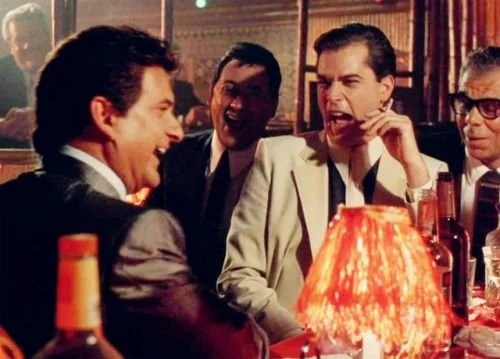
The cool thing about movies like this, ones that are both prestige and comfort movies, is that they can be one thing at one moment in your life, and something else later on. They can even be both at once.
I can put this on and enjoy the great dialogue and fun, or I can put it on and learn something more about the art of filmmaking.
But it is interesting that a movie like this can be so fun. War movies have lots of death and are emotionally tough. This one has a high body count, but it’s extremely entertaining.
So what is it? Maybe it’s that the characters chose this life. Maybe it’s that they do terrible things, so we feel less bad watching them get what’s coming. Maybe it’s that the lifestyle itself is so seductive, it doesn’t matter.
And probably, it’s a combination of all of these things. These characters look into a temptation, a dream most of us want to take, but haven’t taken (unless you’re in the mob; I have zero intel on my connected readers).
We don’t take this path because we know where it leads. Still, we fantasize about it. So we get to live vicariously through these characters, and then we’re rewarded at the end with the reminder: “Yeah, this is why you don’t do this.”
We can live the life by watching Henry, Karen, and Jimmy do it, while staying in our comfortable schnook lifestyle. And with that final shot of Tommy shooting at the screen, Henry fully becomes us: he now thinks about the gangster life the same way we do as he gets the paper (or as Jimmy Two-Times would put it, “gets the paper, gets the paper”).