
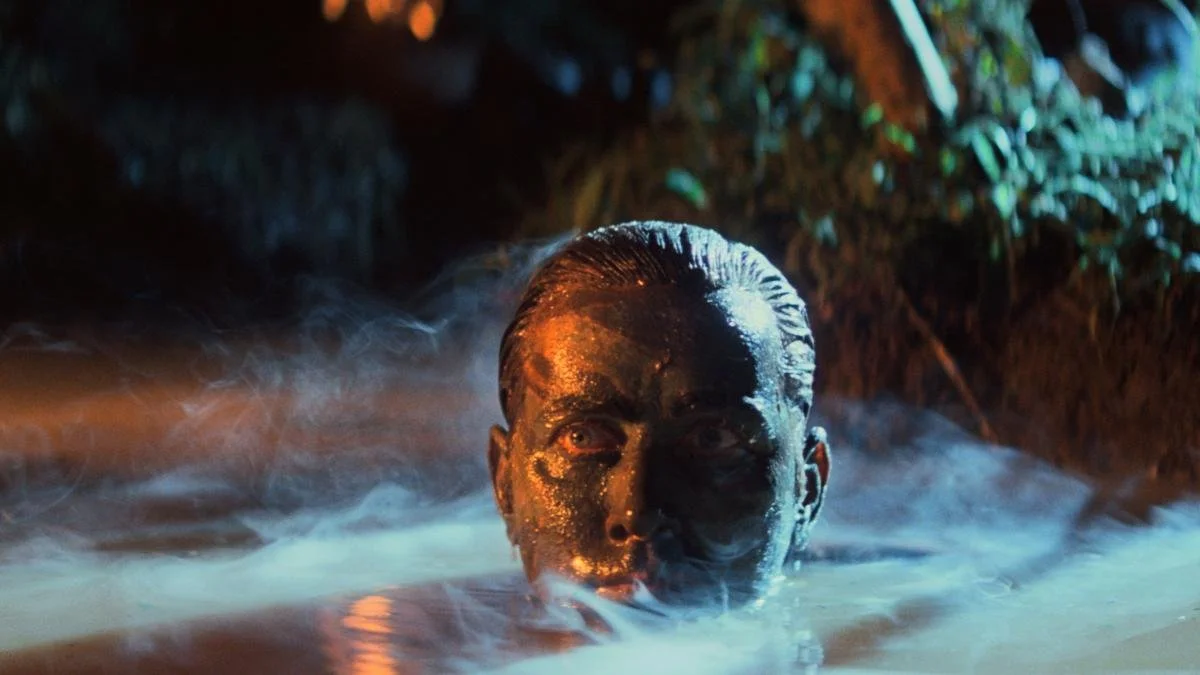
Now that we’re deep into the trenches of war movies, we might as well get to what might be the darkest of them all.
I’m curious what makes this movie feel so dark. Or I should say dark even for a war movie, which isn’t exactly the most cheerful genre to begin with.
From the title alone, which might be one of the darkest in all of cinema, we know we’re in for something heavy.
From Francis Ford Coppola, right in the middle of his legendary hot streak, we have 1979’s Apocalypse Now, written by John Milius and Francis Ford Coppola, and directed by Coppola.
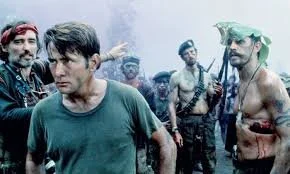
When examining the film’s darkness, we have to look at the message.
Last time, when I reviewed Platoon, I said the message of almost every war movie could be summed up as “war is hell.” But like that movie, Apocalypse Now goes further.
Here, the message is clear: we can all turn to utter darkness.
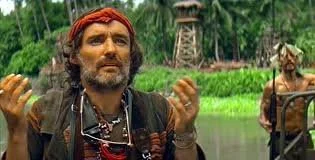
Kurtz isn’t the kind of man you’d expect to fall so far. He was a hero, one of “our guys.” And then he became the bad guy..
Willard makes this discovery himself, starting off as a fairly normal man but slowly descending into madness. By the end, when he raises the machete over Kurtz, we realize he’s capable of the same darkness.
You can see this transformation mirrored in the other characters too: the boat crew that loses order as the mission continues Every character reveals what war can strip away: humanity and the ingredients that make us people.
As I mentioned, Stone movies get dark.
And there’s something about the soundtrack in this that heightens that sad emotion. Similar to the music in Midnight Express, the score (by Georges Delerue and Samuel Barber’s “Adagio for Strings”) is brutal.
Taylor’s inner monologue is also heartbreaking, as you can hear the sound of a defeated man’s voice: “I think now, looking back, we did not fight the enemy; we fought ourselves.”
Add this to the constant sounds of battle, the crying, the screaming, and the sounds of the film are something incredibly haunting.One of the things that makes this movie so unforgettable is its opening scene. Few openings so perfectly say, “This is the journey you’re about to take. I hope you’re ready.”
The combination of The Doors’ “The End,” the surreal visuals, and Willard’s narration plunges us straight into what Coppola wants us to feel: a batshit world that isn’t quite safe.
We get the horror, the chaos, and the moral confusion all at once.
Even Harrison Ford’s teeny tiny but memorable role helps set the tone. We associate him with confidence and charm, yet here he’s anxious and subdued, a symbol of how warped even the confident, Han Solo archetype becomes in this world.
It also bookends like a champ: Kurtz’s voice is the first we hear and the last we confront. The movie begins and ends inside the same fog of cuckoo.
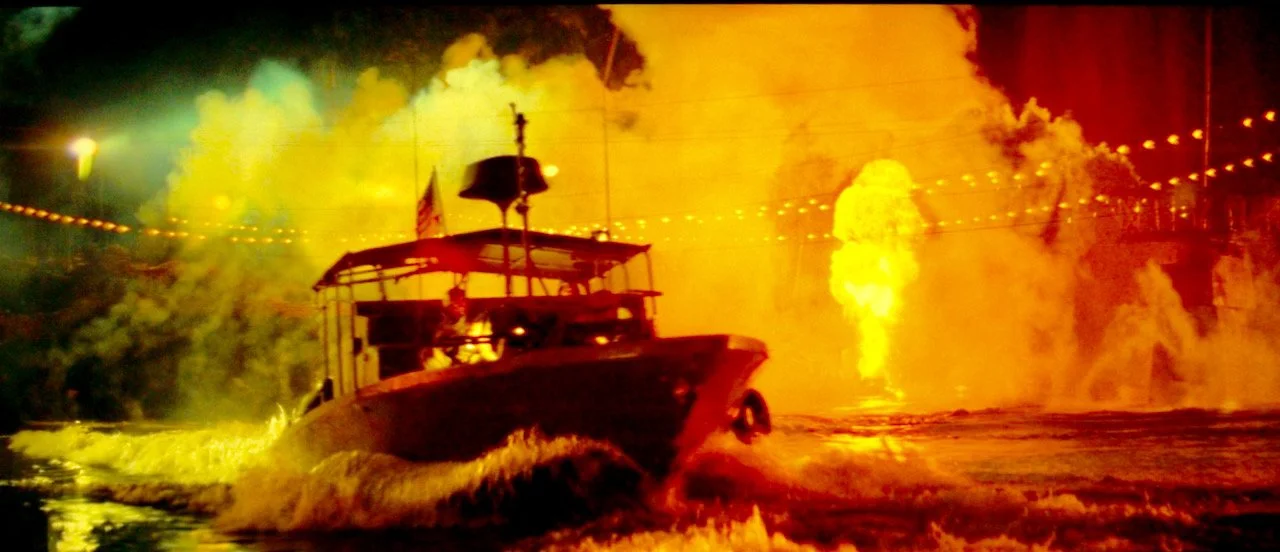
You can’t really talk about this film without mentioning the immortal line: “Pig after pig, cow after cow!” Just kidding. “I love the smell of napalm in the morning.”
It captures the movie’s twisted logic, how something horrific becomes routine. If napalm replaces the smell of coffee, you’re in for a shitty day.
Like Platoon, the enemy isn’t the “other side,” it’s what war turns us into.
Kurtz is just an extreme version of Barnes. He’s what happens when power, violence, and isolation go unchecked.
It’s a damning commentary on war (going back to “war is hell”: it can cause people to lose who they are
We think of the apocalypse as something distant, mythical, or divine. But Apocalypse Now shows that it’s already here, bring in those horsemen guys
And while that’s terrifying, it’s also what makes it artistic. Because if I’m going to experience the apocalypse, I’m glad it’s safely on my side of the TV screen.